 Science
Live coverage from Stockholm follows the 2026 chemistry Nobel reveal by the Royal Swedish Academy of Sciences.
T The Associated Press
The Associated PressScienceLive coverage from Stockholm follows the 2026 chemistry Nobel reveal by the Royal Swedish Academy of Sciences.
The Associated Press Science
Belgian-born physicist Francis Halzen has won the Nobel Prize in physics for work clarifying a rare class of neutrinos. Researchers believe the tiny cosmic particles can reveal clues about how the universe evolved. Halzen is a physicist at the University of Wisconsin-Madison.
The Associated Press Science
Belgian physicist Francis Halzen has won the 2026 Nobel Prize in Physics for contributions to the IceCube Neutrino Observatory, located two kilometres beneath the South Pole. The facility detects neutrinos, nearly massless particles that pass through matter, while their study helps scientists investigate cosmic events including black holes and massive stellar explosions.
 Science
Stanford University released footage of Karl Deisseroth telling his two daughters and one son that he had won the Nobel Prize in medicine. The 54-year-old shared this year’s award with two researchers in Germany for work on optogenetics, which uses light and genes to switch neurons on and off in living brains.
The Associated Press Science
Nobel laureate Francis Halzen said the prize was not what motivated his work on the IceCube observatory, which uses Antarctic ice to detect elusive particles known as neutrinos.
 Reuters
 Science
This year’s Nobel Prize in Physics has been awarded to Belgian scientist Francis Halzen for groundbreaking work on neutrinos, tiny cosmic particles that researchers believe could reveal clues about how the universe evolved.
 Science
Belgian-American Francis Halzen, 82, speaks at a University of Wisconsin-Madison briefing after winning the 2026 Nobel Prize in Physics. He was honored for creating an Antarctic ice observatory to detect high-energy neutrinos, elusive particles that can provide otherwise inaccessible information about the cosmos.
Reuters Science
The University of Wisconsin–Madison is hosting a press conference to recognize Professor Francis Halzen, who has received the 2026 Nobel Prize in Physics.
The Associated Press Science1:47
The 2026 Nobel Prize in Physiology or Medicine went on Monday to American Karl Deisseroth and Germans Peter Hegemann and Georg Nagel. They developed optogenetics, a way to alter the behavior of individual nerve cells in the brain with light.
 Science
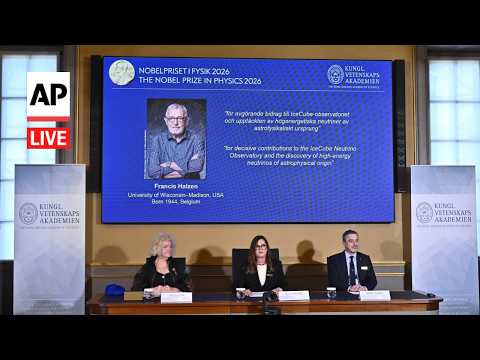
Francis Halzen won the 2026 Nobel Prize in physics on Tuesday for his work to unravel the mysteries of a rare type of neutrino. Scientists believe these tiny cosmic particles could provide clues to how the universe evolved.
The Associated Press Science
The Royal Swedish Academy of Sciences announces the winner of the 2026 Nobel Prize in Physics in Stockholm, Sweden.
Reuters Science
The Royal Swedish Academy of Sciences is revealing the laureate of the 2026 Nobel Prize in Physics.
 Science
The 2026 Nobel physics announcement by the Royal Swedish Academy of Sciences is being streamed live from Stockholm, Sweden.
The Associated Press Science
Karl Deisseroth, Peter Hegemann and Georg Nagel have won the 2026 Nobel Prize in Physiology or Medicine for their work on optogenetics. The light-based biological technique is used to explore the inner workings of the human brain, with possible future applications in treating diseases including Alzheimer’s.
 Global News
 Science
US psychiatrist and neurologist Karl Deisseroth and German colleagues Peter Hegemann and Georg Nagel have won this year’s Nobel Prize in Physiology or Medicine for their work on optogenetics. Their research has helped scientists better understand how the brain works and how the human mind functions.
 BBC News
 Science
American scientist Karl Deisseroth and German scientists Peter Hegemann and Georg Nagel jointly received the 2026 Nobel Prize in Physiology or Medicine. Other top stories included Russian guided bombs and drones killing three people in an October 5 attack on Kharkiv; Secretary of State Marco Rubio saying Washington was closely monitoring reports of plague infection at a Russian laboratory; and Yemen’s government saying its forces had retaken territory overlooking the strategic Bab el-Mandeb strait.
 VOA Chinese
 Science
The 2026 Nobel Prize in Physiology or Medicine has gone to Karl Deisseroth of the United States and German scientists Peter Hegemann and Georg Nagel for pioneering optogenetics. The technique uses light to control nerve-cell activity and has transformed understanding of how the brain works.
 Science
The Nobel medicine prize was awarded Monday to US psychiatrist and neurologist Karl Deisseroth and German scientists Peter Hegemann and Georg Nagel for pioneering work in optogenetics. The technique uses light to control neurons, potentially opening breakthroughs in treating dementia, depression and blindness.
 Science
Neuroscientist Dr. Karl Deisseroth, awarded the Nobel Prize for medicine, says his research has helped scientists identify brain cells involved in disorders such as depression and Alzheimer’s. He also says he struggled to speak after learning of the award.
Reuters Science
The Nobel Prize in medicine was awarded Monday to Karl Deisseroth, Peter Hegemann and Georg Nagel for research on light-gated ion channels and optogenetics. Their light-based tool is helping laboratories around the world investigate how the brain works, the Nobel Assembly said.
The Associated Press Science
The 2026 Nobel Prize in Medicine has gone to American Karl Deisseroth and Germans Peter Hegemann and Georg Nagel for discoveries involving light and optogenetics. The Nobel Assembly at Sweden’s Karolinska Institute said laboratories worldwide use their work to uncover the brain’s mysteries.
 Science
Karl Deisseroth, Peter Hegemann and Georg Nagel have won the 2026 Nobel Prize in Medicine for research on light-gated ion channels and optogenetics, a method offering unprecedented opportunities to map the brain and reveal its mysteries.
 Science
Stanford University in California is celebrating Karl Deisseroth, who won the Nobel Prize in medicine alongside Peter Hegemann and Georg Nagel. The three were recognized for developing a light-based tool to study how the brain works.
The Associated Press Science
Stanford University is holding a press conference after researcher Karl Deisseroth shared the 2026 Nobel Prize in Physiology or Medicine with Peter Hegemann and Georg Nagel. They were recognized for developing optogenetics, which uses light to control individual nerve cells in the brain.
Reuters