 Economy
Shein’s route to a public listing has shifted from New York and London to Hong Kong. The move reflects why the fast-fashion giant had to turn back to its Chinese roots to make the IPO work.
R Reuters
EconomyShein’s route to a public listing has shifted from New York and London to Hong Kong. The move reflects why the fast-fashion giant had to turn back to its Chinese roots to make the IPO work.
Reuters Economy
Shein’s long-awaited Hong Kong IPO could value the online fast-fashion retailer at about $26.5 billion, according to two sources. The figures behind that potential valuation are examined.
Reuters Economy
Fast-fashion giant Shein has launched its Hong Kong initial public offering, ending its years-long pursuit of a listing. The company is seeking to raise up to about US$1.8 billion.
 Economy
Shein built a global fashion empire by selling ultra-cheap clothing worldwide. But ahead of its Hong Kong IPO, its valuation has plunged from nearly $100 billion to about $27 billion.
Reuters Tech
Chinese AI models are rapidly closing the performance gap with US rivals and attracting users through lower prices and open-weight technology, which allows companies to deploy them locally. Bloomberg tech reporter Luz Ding says their capabilities are approaching those of leading US models at a lower cost.
 Bloomberg Television
 Economy
Fast-fashion retailer Shein is seeking a valuation of $26 billion to $27 billion in a Hong Kong initial public offering, according to people familiar with the matter. The target would be sharply below the company’s peak value.
Bloomberg Television Tech
The winner of the technology race may not be the country with the most advanced inventions, but the one that extracts the greatest value from every dollar spent. Roland Lim explains that while the US may lead in invention, China has an edge in manufacturing efficiency.
 Tech
A leaked draft letter from the United States indicates that Washington wants partner countries to choose between its artificial intelligence framework and China’s competing vision.
 Economy
White House trade adviser Peter Navarro says the Trump administration is deploying artificial intelligence against countries helping China evade US tariffs. He says more than 40 countries are involved in China’s transshipment network.
Bloomberg Television Economy
White House trade adviser Peter Navarro says countries helping China evade tariffs are overwhelming US customs officials. He says the Trump administration is using artificial intelligence to identify countries involved in China’s transshipment network.
Bloomberg Television Tech
The Federal Communications Commission announced on 28 July that it would ban humanoid robots from China, including the popular Unitree G1. The Guardian’s technology journalist Nick Robins-Early examines why these robots have recently become so popular. The US government says the devices pose a risk to national security. The move places a widely shared consumer technology trend within a broader security debate.
 Tech
TSMC says its monthly sales increased by 45%. The rise points to continued demand for artificial-intelligence hardware despite volatility in the market. Bloomberg Television reports that the chipmaker’s performance signals sustained strength in the AI hardware segment. The update comes as investors watch how technology demand holds up amid unsettled market conditions.
Bloomberg Television Politics
CNN host Fareed Zakaria brings together his views from July and one additional August segment. He considers how Donald Trump’s NATO policy unintentionally strengthened Europe and how China benefited from the Iran war without firing a shot. The roundup also examines why democratic governments are unpopular across the world. It concludes with a look at Trump’s persistent focus on tariffs and its wider consequences.
 CNN
 Economy
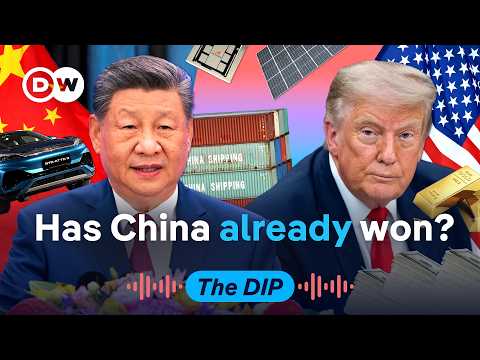
Western policymakers spent years warning about a new “China Shock” as Chinese exports poured into markets worldwide. Beijing is now promoting a different message: China should be viewed as an opportunity rather than a threat. Ahead of important discussions with Washington and Brussels, Chinese officials are defending a state-backed industrial strategy that has produced global leaders in electric vehicles, batteries and clean technology. Critics, however, say those policies distort competition and give Chinese industry an unfair advantage in global markets.
 Politics
West Virginia state Sen. Chris Rose praised the Trump administration’s investment in critical minerals. The Republican lawmaker discussed the administration’s mining-related initiatives on Fox Report. His comments presented the investment as welcome news for the state. The headline highlights Rose’s description of the policy as “music to our ears.”
 Fox News
 World13:58
A 2026 survey by the US think tank Pew Research Center found that China was viewed more favorably than the United States in 25 of the 36 countries surveyed. It marks the first reversal of this kind since Pew began conducting comparable research in 2005. Scholars attributed the shift partly to the Trump administration’s foreign and trade policies, which they said weakened America’s image. China’s work in infrastructure, technology and economic and trade cooperation has meanwhile increased its appeal in some countries. Japan, South Korea and the Philippines still view China negatively, citing geopolitical factors.
 BBC Chinese
 Tech
Humanoid robots have moved beyond the laboratory and are emerging as a major market. Morgan Stanley estimates that the sector could be worth $5 trillion by 2050, with more than one billion humanoids operating worldwide. China is central to the global supply chain, manufacturing robot components at a scale and cost that competitors find difficult to match. The United States has banned imports of foreign-made humanoid robots on national-security grounds and has also blocked power inverters used in data centres.
 World14:47
The White House told VOA that any agreement concerning the Strait of Hormuz should include neither approval requirements nor transit fees. On the 81st anniversary of the atomic bombing of Hiroshima, Japanese Prime Minister Sanae Takaichi pledged to pursue denuclearization. A US Senate hearing examined scams targeting Americans by Chinese criminal groups, while Republican Senator Danes plans to visit China soon. North Korea launched ballistic missiles, prompting heightened alert in the United States, Japan and South Korea. VOA also reported from the USS Roosevelt.
 VOA Chinese
 Tech
The global contest for technological self-sufficiency is gathering pace. The United States and China are competing for leadership in artificial intelligence, advanced semiconductors, AI infrastructure, optical transceivers and robotics. They are also vying for control of the critical supply chains expected to support the next generation of technological innovation. TRT World Digital Lead Abdulvehab Ejupi reports on the competition.
 Economy1:33:20
China’s optical stocks declined after reports that the United States is drafting a ban on Chinese data-center components. The report was discussed on Bloomberg’s China-focused program. The program also examined how Hong Kong and mainland Chinese stocks were lagging behind a broader technology rally. The developments highlight investor attention on potential US restrictions affecting China’s technology supply chain.
Bloomberg Television